Darky Gardiner's Death
The Narrow Road to the Deep NorthDarky Gardiner's Death is reported at the POW camp as a drowning, but Dorrigo Evans immediately records it as murder. The gap between the reported manner of death and Dorrigo’s judgment remains unresolved in the scene; its significance deepens later, when a war-crimes court dismisses a charge concerning Gardiner’s murder on the basis of contradictory written evidence.
The News at the Camp
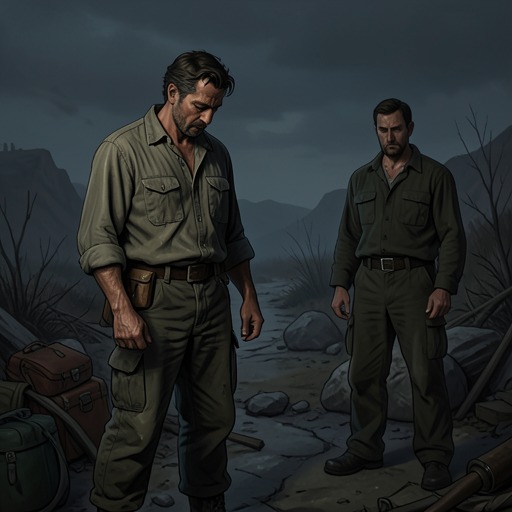
The death is announced late at night, after a long day in the camp. Bonox Baker comes to the officers’ tent with news that Darky Gardiner has drowned. Dorrigo is not present at the death, and the account provides no circumstances explaining how Gardiner entered the water or what happened there. The scene therefore gives the reader the news and its immediate reception, not an independently established account of the death.
At dawn, Dorrigo intends to meet a hundred men arriving for departure and wish them well. The news reaches him as he prepares to face another day of camp responsibility, placing Gardiner’s death beside the continuing movement of prisoners through the railway system. The contrast is stark: the men are counted and sent onward, while a death that Dorrigo believes to be murder must first be entered in a private diary.
Dorrigo’s Record
By lantern light, Dorrigo writes the word murder in his diary. He finds the word inadequate, but the narration does not supply another explanation or name a perpetrator. His entry is thus both a record of his judgment and an expression of how little a single word can contain. The account gives no further evidence in this moment that resolves the cause of death.
Dorrigo sees his reflection in a small shaving mirror beside the diary: unkempt, exhausted, and altered by the life of the camp. He turns the mirror face down and tries to sleep before morning. The gesture links the written record to a wider burden of witnessing: he must preserve what he can, yet continue functioning amid repeated loss, with no promise that either the diary or his judgment will settle what happened.
Later Court Proceedings
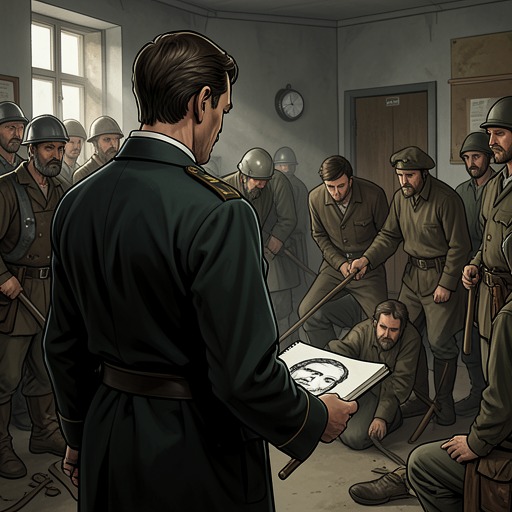
The postwar proceedings involving Choi Sang-min revisit the accusation connected with Gardiner’s death. In an Australian military court, the charge that Choi participated in the murder of Australian Imperial Force Sergeant Frank Gardiner is dismissed because the evidence presented through written testimonies is contradictory. Choi’s trial does not establish who caused Gardiner’s death, and the dismissal does not erase the judgment Dorrigo made at the camp; it leaves the accusation unresolved on the evidence described.
The court does uphold separate charges against Choi, including ordering the murder of Wat Cooney and ill-treatment involving the withholding of food and medical supplies. The distinction matters: the verdict is not a finding that no abuses occurred, but neither does the evidence provided turn Dorrigo’s diary entry into a proven account of Gardiner’s death. The episode sets the immediacy of a witness’s private record against the limits of a later, incomplete legal process.
Memory and the Railway
The camp’s deaths belong to a forced-labour system whose losses resist complete accounting. The novel describes Australian prisoners among hundreds of thousands of enslaved labourers on the Death Railway, alongside Asian civilian workers whose death toll remains disputed and whose names, it says, have already been forgotten. This larger setting gives Dorrigo’s diary entry a weight beyond its single word: individual testimony stands against an immense history in which the dead are often reduced to uncertain totals or omitted altogether.
The railway’s public commemoration sharpens that contrast. The displayed locomotive C 5631 is associated with a memorial that records the names of those who died in service to Japan, including convicted war criminals, while its plaque makes no mention of the railway’s construction or the labourers who died there. Gardiner’s death is not identified in the evidence as one of the names or omissions on that plaque. Rather, the juxtaposition frames the problem the scene leaves open: how to remember a death when the immediate account is contested and the institutions that preserve history do not preserve every victim’s story.